


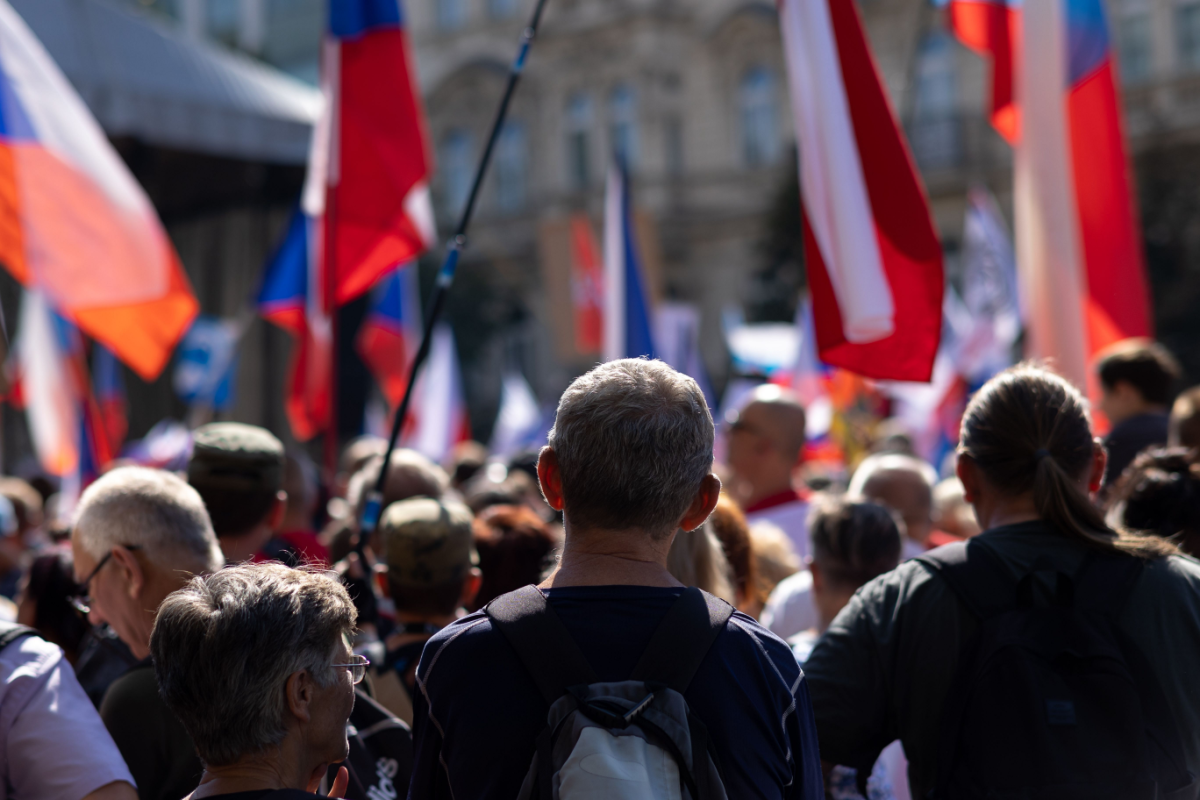
Tens of thousands of people gathered in Prague on Sunday to support Czech President Petr Pavel amid an escalating dispute with the government and the country’s foreign minister. The protests reflect growing public concern over political standards, democratic norms, and the direction of the Czech Republic’s leadership.
Large Rally in Support of the President
Organizers estimated that between 80,000 and 90,000 demonstrators attended the rally in Prague’s Old Town Square, although police did not release official figures. Protesters waved Czech, European Union, and Ukrainian flags, signaling support for democratic values and continued alignment with Europe.
The Million Moments for Democracy movement described the situation as unprecedented, condemning what it called an unacceptable attempt to pressure the president. In a public message, President Pavel thanked participants for standing up for decency, truth, solidarity, and mutual respect.
Accusations of Blackmail
The dispute intensified after President Pavel accused Foreign Minister Petr Macinka of attempting to blackmail him over a cabinet appointment. Pavel released text messages in which Macinka allegedly warned of severe political consequences if the president continued to block a controversial ministerial nomination.
Macinka, who also serves as environment minister, defended the messages as part of standard political negotiations, arguing that high level politics requires resilience rather than sensitivity.
Controversial Ministerial Nomination
At the center of the conflict is President Pavel’s refusal to appoint Filip Turek as a government minister. Turek, nominated by the eurosceptic Motorists for Themselves party, has been linked to a series of scandals, including social media posts described as racist, homophobic, and sexist.
Turek has also faced criticism for appearing to perform a Nazi salute and for posting images of Nazi memorabilia. Although he has apologized for some content and denies extremist sympathies, Pavel has argued that Turek’s behavior raises serious doubts about his commitment to constitutional values.
Political Context and Government Direction
The dispute unfolds against the backdrop of a new government formed after elections won by former prime minister Andrej Babis and his populist ANO movement. Babis leads a coalition that includes the Freedom and Direct Democracy Party and the Motorists for Themselves.
The coalition has signaled a shift away from strong support for Ukraine and skepticism toward key European Union policies. President Pavel, a retired army general, has taken a sharply different stance, remaining a vocal supporter of Ukraine in its defense against Russia.
Planned Protests and Public Reaction
Organizers announced further demonstrations across the Czech Republic later this month, suggesting the conflict has mobilized sustained civic engagement. The rallies highlight a broader debate over democratic culture, political ethics, and the balance of power between the presidency and the government.
Conclusion
The mass protests in support of President Petr Pavel underscore deep political tensions within the Czech Republic. As disagreements over ministerial appointments and foreign policy continue, the dispute is shaping into a wider test of democratic norms, public trust, and the country’s future direction.
