


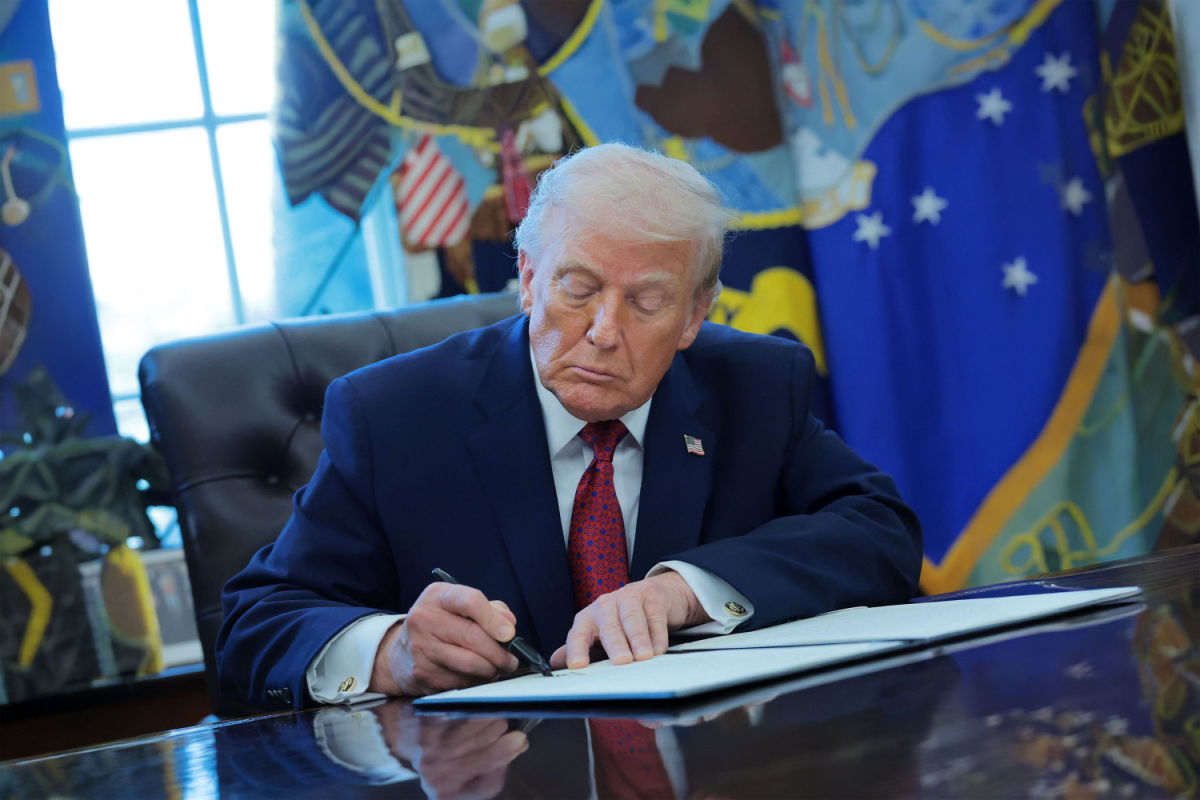
Funding Commitment Announced at First Meeting
WASHINGTON — President Donald Trump announced that the United States will contribute $10 billion to the Board of Peace, an international body he launched in January aimed at rebuilding Gaza and supporting stability in other conflict zones.
Speaking at the organization’s inaugural meeting in Washington on Thursday, Trump said additional member countries would contribute billions more and provide troops for Palestinian security efforts.
“The Board of Peace is showing how a better future can be built starting right here,” Trump told attendees, which included 17 world leaders, Vice President JD Vance, Secretary of State Marco Rubio and U.S. Special Envoy to the Middle East Steve Witkoff.
“We will help Gaza. We will straighten it out. We will make it successful. We will make it peaceful,” Trump said, adding that the board would lead similar efforts elsewhere.
International Contributions and Reconstruction Costs
Beyond the U.S. pledge, seven additional countries — including Kazakhstan, Azerbaijan, the United Arab Emirates, Morocco and Saudi Arabia — have collectively committed more than $7 billion for Gaza relief, according to Trump.
The United Nations Office of Humanitarian Assistance is raising $2 billion, and FIFA plans to raise $75 million and organize visits by World Cup soccer players to the territory.
Rebuilding Gaza is estimated to require approximately $70 billion following two years of war with Israel.
Security Framework and Stabilization Force
The Board of Peace was approved by the United Nations Security Council last year as part of Trump’s 20-point peace initiative. A ceasefire began in October, with a second phase in January focused on demilitarization and reconstruction.
During Thursday’s meeting, Albania, Indonesia, Kazakhstan, Kosovo and Morocco pledged to form an armed International Stabilization Force to oversee security and disarm Hamas. Egypt and Jordan committed to training a Palestinian police force.
U.S. Maj. Gen. Jasper Jeffers said American military experts are already preparing infrastructure for stabilization headquarters in Gaza. The long-term objective includes deploying 20,000 stabilization troops and training 12,000 police officers, beginning with operations in Rafah.
Long-Term Vision for Gaza
Board member Yakir Gabay emphasized the scale of reconstruction ahead, including removing 70 million tons of rubble and dismantling extensive underground tunnel networks. Immediate priorities include temporary housing for nearly 2 million displaced residents.
Apollo Global Management CEO Marc Rowan outlined plans for 100,000 homes in Rafah to serve 500,000 residents, supported by $5 billion in infrastructure. Over time, 400,000 homes and more than $30 billion in infrastructure investment are envisioned.
A presentation at the meeting projected that by Year 3, Rafah would be rebuilt and unemployment reduced, while by Year 10, Gaza would be self-governed and economically integrated with regional partners.
Global Reaction and Concerns
More than 40 countries and the European Union sent representatives, though several invited nations — including France, Germany and the United Kingdom — declined to join, citing concerns that the Board of Peace could rival the United Nations.
French President Emmanuel Macron said last month that aspects of the board’s charter “raise serious questions,” particularly regarding the UN’s institutional role.
The board unanimously approved a resolution establishing financial integrity and transparency principles during its first meeting, according to the White House.
