


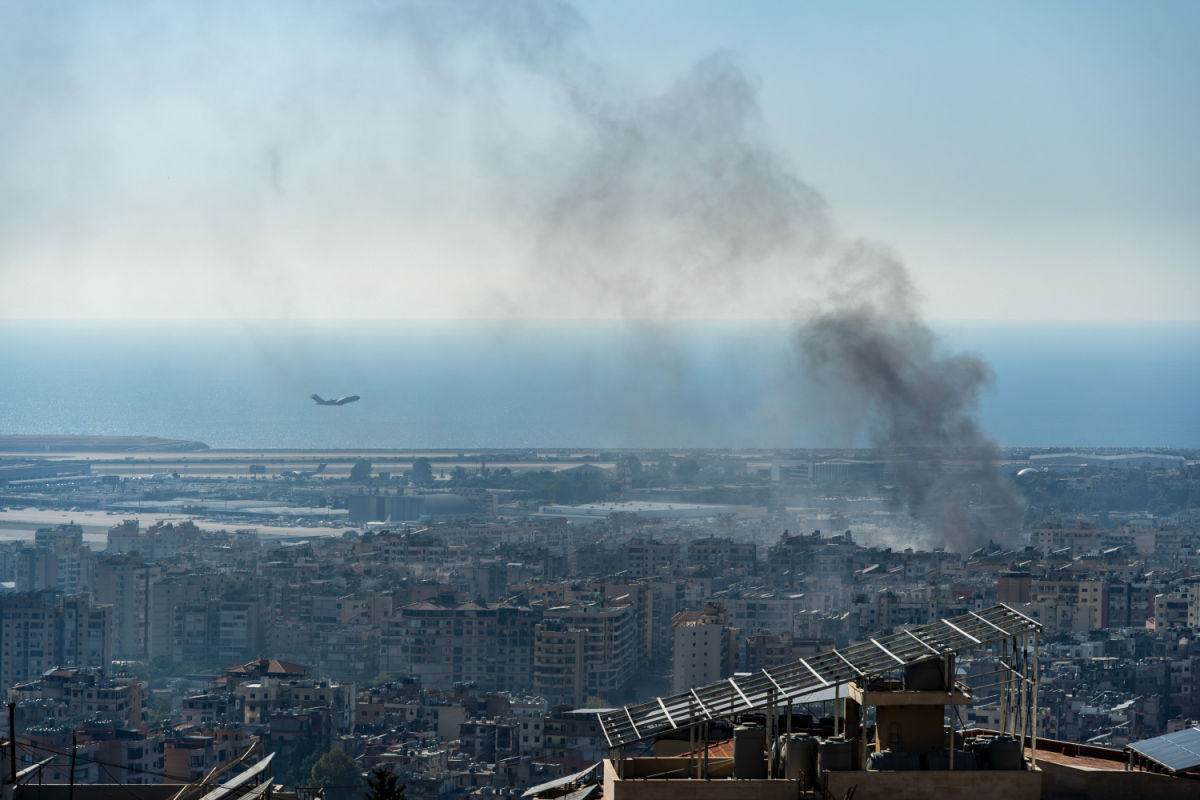
Israel launched major airstrikes on Beirut’s southern suburbs after issuing a Beirut evacuation order for an area home to more than 500,000 people. The Israel Defense Forces told residents to leave immediately, triggering heavy congestion and panic across the Lebanese capital. The directive covered a wide zone that included hospitals and government ministries, according to the report.
Footage from Thursday evening showed smoke rising over Dahiya, a neighborhood where Hezbollah holds deep influence. Israel said it targeted Hezbollah assets in the area. Israel’s far-right finance minister Bezalel Smotrich said the suburb would “look like Khan Younis,” a remark that underscored the scale of the threat being signaled.
Escalation in Lebanon as Wider War Intensifies
The Beirut strikes marked a sharp escalation in Israel’s Lebanon campaign, which accelerated after Hezbollah fired missiles and drones into Israel on Monday. The report described the evacuation instruction as unprecedented in breadth, even compared with the 2024 Israel-Hezbollah war. Traffic gridlocked across the city, and some families walked with children and strollers amid stalled vehicles.
The Israeli military circulated specific routes north and east for civilians to use. The approach echoed prior Israeli evacuation guidance used in other conflicts. Families appealed for help for elderly residents and people unable to move without assistance, the report said.
Lebanon’s health ministry reported at least 102 killed and 638 injured from Israeli airstrikes before Thursday night’s bombardment. The same account said the war had killed at least 1,230 people in Iran and about a dozen in Israel. It also said six US soldiers had been killed.
Trump, Katz and Competing Narratives on Iran
In Washington, President Donald Trump said members of the Islamic Revolutionary Guards Corps would receive immunity if they surrendered. He warned of “guaranteed death” for those who did not. Trump also said the United States should be involved in selecting Iran’s next supreme leader, after Ayatollah Ali Khamenei was killed in the opening phase of the conflict.
Trump told Reuters he viewed Mojtaba Khamenei, the late leader’s 56-year-old son, as an “unacceptable” successor. He said Washington wanted influence so it would not face the same crisis repeatedly. Separately, US defense secretary Pete Hegseth signaled further escalation, saying, “If you think you’ve seen something, just wait.”
Israel’s defense minister Israel Katz added a new claim that could sharpen criticism of the US role. He said the decision to assassinate Khamenei was made in November, well before the collapse of nuclear talks. Katz said the original timeline involved action in mid-2026 but was accelerated after riots in Iran. The report said this claim could strengthen critics who argue Israel pulled the US into a larger regional war.
Katz also warned that Khamenei’s successors would be “unequivocal targets for elimination,” according to the report. That stance points to continued leadership-focused targeting in the days ahead.
Regional Strikes Spread, Markets and Travel Disrupted
The conflict widened as Iran fired more ballistic missiles toward Israel, while strikes and incidents were reported across the region. The report said an airport in Azerbaijan was hit, and that the war now affected 14 countries. It also described the largest travel disruption since Covid, as airspace closures stranded large numbers of travelers and disrupted air cargo.
Gulf states reported incoming projectiles, which Iran said targeted US bases and personnel. A drone was shot down near Al Dhafra airbase in the United Arab Emirates, with six people wounded by falling shrapnel, according to the report. Qatar reported a missile attack on Doha, while Saudi Arabia said it destroyed a drone.
The report also said a tanker was attacked off the coast of Kuwait, with damage unclear. In Azerbaijan, it said a drone strike wounded four people near an airport in Nakhchivan, and another drone fell near a school. Azerbaijan’s president Ilham Aliyev called it a “groundless act of terror and aggression” and said the military was ready to respond. Iran denied responsibility, the report said.
In another escalation at sea, the report said Sri Lanka recovered at least 87 bodies after a US submarine sank the Iranian warship IRIS Dena. It said 32 sailors were rescued from a crew of almost 130. Iran’s foreign minister Abbas Araghchi condemned the sinking as an “atrocity of sea,” and warned the US would regret the precedent.
As the strikes expanded, the report said oil prices jumped and supply routes faced added risk. The same account described continued US and Israeli attacks on Iranian missile launchers, weapons caches and security installations. It also said Israel warned residents in eastern parts of Tehran to evacuate, while Iranian media reported blasts across the capital.
